Seven Months in Blur
The anatomy of an $87,989.87 mistake — day by day, lie by lie. Case 01 of The White Box.

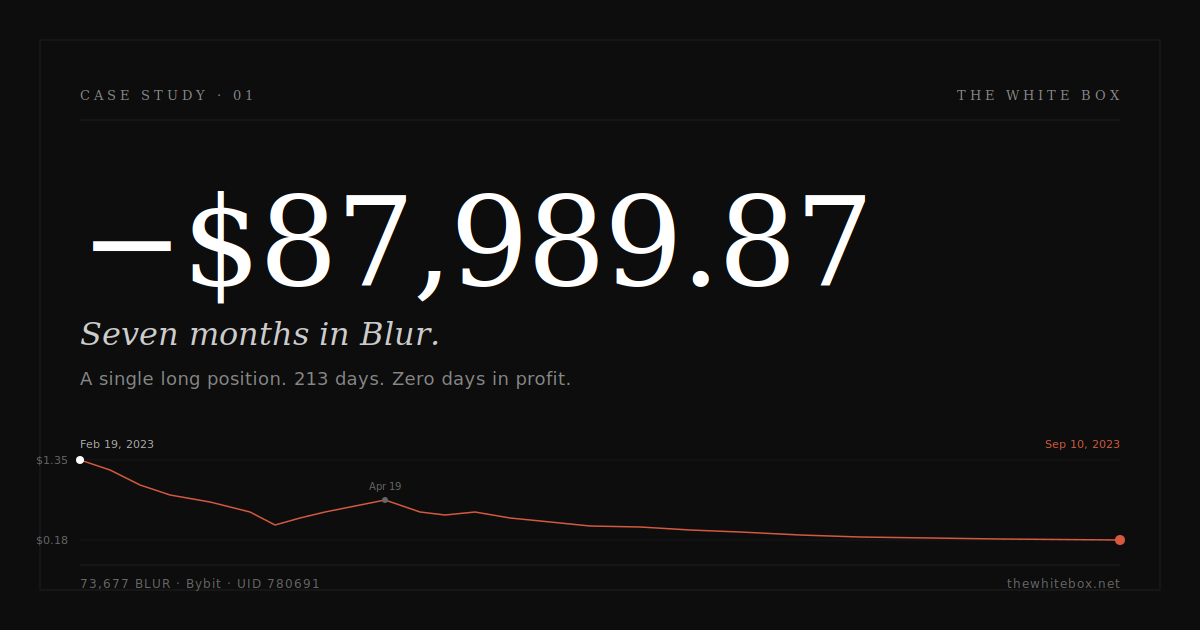
That’s what I lost on a single trade in 2023. Not in a flash crash. Not in a liquidation cascade. Over 213 days of consciously holding a position that was wrong from day one. Zero days in profit. One exit window I refused to take. A Sunday morning in September that I still feel in my hands.
This is the most expensive trade in my career, broken down hour by hour, news cycle by news cycle, lie-to-myself by lie-to-myself.
It is also Case 01 of The White Box — and the reason I’m starting the project with my own worst trade is that I think the crypto industry has a structural blind spot. We have an entire genre of content built around how someone caught the next 100x. We have almost nothing about losses that are analyzed. Confessed, sometimes. Analyzed, rarely.
I’m going to fix that, starting here.
🔍 New here?
The White Box is post-trade analytics for crypto traders. I take real trades — mine, and submissions from other traders — and break them down with the full math, the exact timestamps, the macro events that hit during the hold, and the cognitive patterns that produced the decision. Subscribe to get every case study in your inbox, plus the framework I’m building from each one.
Why I’m writing this now
The industry is saturated with how-someone-made-it stories. We get the chart, the entry, the exit, the lifestyle photo. What we don’t get is a clean look at how the same brains, the same accounts, the same tools also produce the trades that lose you a house deposit in 213 days.
I want to build the library that’s missing. A reference of real losses, with the math shown, the dates pinned, the macro context laid out next to the emotional state. Not a confession booth. A specimen collection.
I can’t promise that publishing this analysis will make me stop making these mistakes. They’re built into how human cognition meets leverage. But I can promise this: naming the mistakes precisely makes them rarer. And the way you get other traders to share their pain is by going first.
So I’m going first.
Three positions in my own account destroyed approximately $155,000 between 2023 and 2026.
Blur is the first one. The other two — long BTC at $124,664 on October 10, 2025, and short BTC at $69,793 on April 17, 2026 — are being written up next. More on those at the end of this piece, and in the cases that follow.
February 14, 2023. The setup.
To understand why I entered, you have to remember what the NFT sector looked like that month.
OpenSea, the long-running monopolist, was losing share. Blur — a marketplace built for professional flippers, with zero fees, aggregated listings, and instant bidding — had already overtaken OpenSea in trading volume by early 2023. This was not “another marketplace.” This was the takeover of the segment.
On February 14, Blur ran its Season 1 airdrop: 360 million tokens distributed to active users. Some wallets received 128,000 BLUR each. In the first hours after Coinbase listed it, BLUR traded above $5. By the end of the same day, below $1. The recipients were dumping.
I watched the cycle from the side. And I saw in it what I wanted to see: the token was oversold, the fundamentals were strong, the platform actually worked, and a bounce was inevitable.
February 19, 2023. The trade before the trade.
Here’s what most people miss when they tell a story like this: the catastrophic trade almost never happens in isolation. It happens right after a winning trade.
It was a Saturday. My husband was getting ready — we were going out somewhere. While he was organizing the morning, I had some time alone with the screen, and I made a long position on a different token that printed money. Around ten thousand dollars, give or take. I don’t remember the exact figure now, which itself is a tell — that win didn’t matter compared to what came next.
What it gave me was not money. It gave me a chemical state. Euphoria. The conviction that I could read the tape. The conviction that the market was about to keep going, and that I was sitting in the right chair at the right moment. And it was going. Which made the feeling worse, because the market kept confirming me in real time. My body chemistry was firing. I felt sharp. I felt right.
The trade I’m about to tell you about is what happened when I tried to scale that feeling.
February 19, 2023, 06:32 UTC. The first short.
I opened a small short. 50,000 BLUR at $1.366. I closed it the same day at $1.40. +$1,699.
This trade matters, but not for the size. It matters because it gave me a false confirmation that I understood Blur’s price action. I had now made money on BLUR twice — once on the warmup token, once on this short. Three for three on the morning.
I wasn’t focused. My husband was almost ready. We were about to walk out the door. I wanted one more — one bigger one — before we left. Pure emotion. No thesis review. Just the chemical state of a body that had been right twice in a row and wanted to be right a third time, faster.
So I clicked.
The long entry. The decision I wish had a pause.
The same day, a few hours later, I opened a long position on 73,677 BLUR at $1.350.
The notional value of that position was $99,464. My free USDT on Bybit at that moment was around $80,000, plus about $7,000 in BIT tokens. The position was larger than my entire portfolio. With leverage, obviously.
I want to be specific about what happened in my head when I clicked, because I think it’s the most universally recognizable moment in this whole essay. Other traders will read this and recognize themselves.
I did not set a stop-loss. I did not even consider one. It wasn’t that I considered one and rejected it — it never crossed my mind. There was no internal voice asking “what if this goes against me.” There was no pause before clicking. There was no five-minute window where I sat back and asked myself whether I had actually done research on this token, or whether I was just riding the emotional wave from the morning’s wins.
I had heard, somewhere — in some Telegram chat, on some Twitter feed — that Blur was a “good project” that would “do Xs.” That was the depth of my research. That was the entire substrate of a hundred-thousand-dollar position.
And the most terrifying part isn’t that I didn’t research. It’s that I didn’t wait. There was no pause. The reasoning, to the extent I had any, was: the token is still active, it’s still popular, if I don’t move now it might dump further. So move now.
This is the part of trading that doesn’t get talked about enough. People analyze entries as if they’re decisions. Sometimes they aren’t. Sometimes they’re the trailing edge of a chemical state that started two trades ago.
Side note: this exact pattern — catastrophic position opened immediately after a winning one, with no pause and no stop — is what produced both of my next two disasters too. By the time we get to October 2025 and April 2026, the structure is identical. Same body, same morning, different token. Subscribers will get the full breakdowns as they go up. — Subscribe to follow the series.
February 19–22. The first 72 hours.
The price moved in exactly the opposite direction of my thesis.
February 19 close: $1.32 (–2.4% from entry)
February 20: $1.25 (–7%)
February 21: $1.18 (–13%)
February 22: $0.98 (–27%)
In three days the position was down $27,000. And right here — at the breaking of the psychological $1 level — I broke a rule I knew theoretically: I did not exit when the thesis failed to confirm in the first 24 hours.
What happened in my head instead was the first lie. And it had a very specific structure: the market will reverse. The price will reverse. The loss is too big to close at.
That last sentence is the trap. Not “the loss is too big” — that’s just emotion. The trap is the word “at.” “Too big to close at“ implies that there exists a future moment when the same loss won’t be too big to close. And the only way that future moment exists is if the price comes back. Which means I had quietly converted my trading position into a prediction about the future, and made my own future emotional comfort depend on that prediction being true.
This is sunk cost fallacy, but it never arrives in your head wearing its own name. It arrives as a reasonable-sounding argument about fundamentals.
March 10–13. SVB and USDC.
On March 10, 2023, Silicon Valley Bank collapsed. On March 11, Signature Bank followed. SVB held $3.3 billion of Circle’s reserves backing USDC. The market figured this out over the weekend, and USDC depegged to $0.88.
Crypto entered systemic panic. Altcoins fell two to three times harder than BTC. BLUR dropped from $0.78 to $0.55 across those days.
My position was now down $58,500. Three-quarters of my original $80k portfolio, gone in display value.
This is roughly one month into the trade. I am sitting in an enormous loss. And I am not allowing myself to close, because I am still — still — assuming the market will reverse.
I want to be honest about this part: it is genuinely stupid. You can say you’ve never seen a more idiotic way to trade. You’d be right. But this is a real, lived case from my own practice, and the reason I’m describing it in detail is that I think it’s the most common form of losing trade — far more common than the dramatic blow-up. The slow-bleed bag-hold, where the trader is fully aware the position is wrong but is paralyzed by the size of the loss.
I knew I still had room to liquidation. The liquidation price was far away. So the displayed minus number scared me, but not enough to act. I told myself: I cannot close at this loss. I wasn’t waiting for profit anymore. I was waiting for less minus.
And I didn’t tell anyone. Not friends, not other traders, not my husband in any detail. I was ashamed. And shame is what closes off the optionality you actually need in moments like this — because there were other things I could have done. I could have hedged the position. I could have opened an offsetting short on a correlated asset. I could have at least sized down. But every cell of my attention was locked on the underwater position itself, on the question of “how do I get out of this drowning,” which is the wrong question, because drowning is not a problem you solve by staring at the water.
By March 13, the U.S. Treasury announced it would protect SVB depositors. USDC repegged. Altcoins bounced. BLUR recovered to $0.67. My loss narrowed from –$58k to roughly –$50k.
And that, in some way, was worse than if BLUR had stayed at $0.55. Because the bounce gave me a new argument: the fundamentals are holding, the panic is past, now we catch up.
April 14–19. The only spike of hope.
On April 12, Ethereum executed the Shanghai hardfork — stakers could finally withdraw staked ETH. The market had braced for a massive sell-off. It didn’t come. ETH rallied.
In parallel, Blur announced its Season 2 airdrop. On April 14, BLUR began moving: $0.59 → April 17 $0.71 → April 19 $0.78.
That’s a 32% rally in five days. My position moved from –$55k to –$42k.
And here is what I did with that information. Instead of treating it as an exit window, I treated it as proof the trend was reversing. I told myself: look, the minus is getting smaller. If it went from –54 to –42, it can go from –42 to –30, and from –30 to –15, and from –15 to zero. All I have to do is wait.
This is exactly the same internal mechanism as in February, just with smaller numbers. The loss is getting smaller, so I should wait longer. I was now in the second month of the trade and I had still not asked myself the only question that mattered: if I had clean cash right now, would I open this position at the current price? If the answer is no, you are not holding an investment. You are bag-holding. And the longer you hold, the more expensive your refusal to ask that question becomes.
On April 20, BLUR turned over. By April 24: $0.59. By May 1: $0.68. By May 14: $0.48.
The window closed. I did not use it.
⚠️ Quick interruption.
If you’re reading this far, you already understand what this kind of breakdown does — both as analysis and as protection. Case 02 is in the editing stage right now: October 10, 2025 — long BTC liquidated at the peak of crypto’s largest deleveraging event in history ($19B wiped in a single cascade). Case 03, after that: April 17, 2026 — short BTC squeezed during the Iran ceasefire rally. Both are bigger losses than Blur. Both follow the exact same structural pattern you just read about.
You can subscribe to get them as soon as they go live. Free.
May–July. Numbness.
This period is harder to describe because it had no events. Just slow attrition. $0.48 → $0.45 → $0.40 → $0.35 → $0.31.
But my life outside the screen had events. I was leaving one company and joining another. Job transitions take a specific kind of emotional energy — they demand focus, optimism, the ability to walk into a new room and present a version of yourself that is forward-leaning, capable, hopeful. And I was carrying this position the entire time. Like a stone in my pocket that I couldn’t put down because putting it down would have meant closing the trade and admitting the number.
The number was the thing. To earn that amount of money — the kind of money I was watching evaporate in display — would take many months of work. I was going to walk into a new role and start from a balance that didn’t reflect what I had earned. It reflected what I had given back, voluntarily, through one stupid clicked button on a Saturday morning. There was anger in it. There was apathy in it. And there was the very specific weight of knowing you carry this thing alone, because you haven’t told anyone.
What kept me in the position through May, June, July was a sentence I heard everywhere in crypto Twitter that summer: “the bull run is coming.” People were predicting it. Many were saying Blur specifically was a quality project. I kept believing. I kept hoping the price would be better.
On June 15, BlackRock filed for a spot Bitcoin ETF. The crypto narrative turned. Wall Street had arrived. BTC began to rally. ETH began to rally. Major altcoins began to rally.
BLUR did not.
It went from $0.40 to $0.36 to $0.32. While the entire market was greening, my token stayed red. This was the signal I could no longer ignore: the problem is not the market. The problem is the token.
But “knowing the trade is lost” and “closing the trade” are two different acts, separated by an emotional layer most people underestimate. I had been knowing the trade was lost for months. I was still in it.
The hope was no longer about reversal. The hope had shrunk to a smaller, sadder shape: maybe the negative balance will be a little less when I finally close. Blur kept making announcements. Each announcement gave me 24 hours of artificial hope. Then the price kept doing what the price was doing.
August. The acceptance.
By August, the hope was gone. Fully gone.
I understood it was a complete write-off. I had no more clever ideas, no more strategies, no more reframes. There was no more “maybe if I hedge” or “maybe if I wait for an announcement.” There was just the position, sitting there at $0.20, and me, watching it.
I was waiting for liquidation. That was the plan. The plan was: do nothing, let the engine close it for me, accept the cleanup. Because I genuinely felt there was nothing left to save.
This is a state I want to name precisely, because I don’t think it’s discussed enough. It’s not panic. It’s not denial. It’s not even depression in the clinical sense. It’s a kind of strategic exhaustion — when the cognitive cost of evaluating new options exceeds your remaining capacity, and you simply hand the decision to the machine.
Liquidation, in this state, feels like relief.
September 10, 2023. The Sunday.
Sunday again. A day off. Morning.
I understood there was no point in waiting anymore. I washed my face. I made coffee. I sat down at the screen, and I closed the position myself.
73,677 BLUR at $0.176. Realized loss: –$87,989.87.
I didn’t want liquidation. I wanted to take the action. I understood the size of the loss and I wanted my hands on it, not the engine’s.
What happened next is the part of the trade that doesn’t have numbers.
My legs and hands went numb. I literally couldn’t speak for a stretch of time — I don’t know how long, maybe a minute, maybe more. The apartment around me was empty. There was no one there. But I felt a specific kind of deaf silence settle on the room, the kind of silence that has weight, that you can almost hear.
Then I stood up.
And I said to myself: “This is the best and harshest lesson you’ve ever taken. This is all I’ll remember from this period.”
That’s true. Almost three years later, that’s what I remember.
Four mistakes that make this trade reproducible
Two weeks after I closed, BTC began the BlackRock rally that would carry it to $48k by January 2024 and to $73k by March. The crypto winter ended. BLUR did not go anywhere. At the time I’m writing this (May 2026), BLUR trades below $0.10. My 73,677 tokens would be worth less than $7,000 today.
This is not a story about bad timing. It’s a story about four specific mistakes — each one recognizable to anyone who has traded altcoins. The structural breakdown with the rule derived from each mistake lives on the case page. Here, in short:
Mistake #1: I opened a position larger than my entire portfolio. This wasn’t trading. It was a binary bet. The moment I sized that way, I had already eliminated stop-loss as an option, because any stop at that size would have been catastrophic.
Mistake #2: I mistook a counter-trend bet for a contrarian one. Contrarianism works against majority emotion, not against majority facts. The facts at entry were screaming: airdrop recipients were dumping, no vertical buyer was visible. That’s a slowly burning fuse, not a contrarian setup.
Mistake #3: I refused to exit in April. When the market handed me an exit at –$42k instead of the –$88k it eventually became, I reframed it as confirmation of my thesis. This is the most expensive of the four — because the first three I could plausibly blame on inexperience. This one I can only blame on my refusal to admit the first three.
Mistake #4: I held a position for 213 days without re-validating the thesis. I never sat down and asked: if I had clean cash right now, would I open this position at current price? If the answer is no, you are bag-holding, not investing.
Why The White Box exists, and why you should stick around
After I closed Blur, I had roughly $30k left. By June 2024, $679. I went on to enter two more catastrophic single-position trades — long BTC at the ATH on October 10, 2025 (during the $19 billion liquidation cascade), and short BTC during the April 17, 2026 Iran ceasefire short squeeze. Together, those three positions destroyed approximately $155,000 against $80,000 of net deposited capital.
Three trades. One structural pattern, manifested three times.
That’s what The White Box is for. Every case I publish breaks down one trade — mine or someone else’s — at the level of detail you just read. Full timestamps. Full math. Full macro context. And then the structural pattern extracted, named, and turned into a rule you can apply to your own positions.
Other ways to follow:
🌐 Full case studies, glossary, and reading order: thewhitebox.net
📊 Structured version of this case with phase tables and macro chronology: thewhitebox.net/cases/blur-2023
💬 Telegram channel for announcements and short reads between cases: @thewhiteboxcrypto
✉️ To submit your trade for analysis: reach me through any of the above.
The market is the same for all of us. The cognitive traps are the same for all of us. The least we can do is share what they look like up close.
— Sani, founder of The White Box